Introduction

These confirmation bias examples show how easily existing beliefs can influence what we notice, trust, remember, and share.
The bias occurs when we notice, remember, and trust information that supports what we already believe while overlooking evidence that challenges us.
Many real life confirmation bias examples begin with a reasonable assumption that gradually becomes resistant to contradictory evidence.
Everyone experiences confirmation bias. It is not a sign of low intelligence or dishonesty. Our brains must process enormous amounts of information, so they rely on mental shortcuts. Accepting familiar ideas is often faster and more comfortable than reconsidering a belief from the beginning.
The problem is that this shortcut can distort judgment. It can make false stories feel credible, weak investments look promising, and poor decisions appear justified. Understanding confirmation bias is therefore an important part of critical thinking, data literacy, and responsible decision-making.
What Is Confirmation Bias?
The American Psychological Association defines confirmation bias as the tendency to seek or emphasize evidence that supports existing expectations while dismissing conflicting evidence.
Imagine that you believe your neighborhood has become more dangerous. You begin noticing every police car, broken window, and suspicious-looking stranger. At the same time, you barely register the hundreds of ordinary, peaceful interactions happening around you.
Your belief acts like a filter. It does not necessarily invent information. Instead, it changes which information receives your attention.
Confirmation bias can affect three stages of thinking:
- Searching: We look for information that supports our opinion.
- Interpreting: We explain ambiguous evidence in a favorable way.
- Remembering: We recall supporting examples more easily than contradictions.
This is why two people can examine the same evidence and reach completely different conclusions.
Want More Real-Life Examples?
If you enjoy learning how statistics, graphs, and cognitive biases can mislead people, download our free PDF:
“25 Ways Statistics Can Mislead You”
Inside you’ll discover practical examples you can recognize every day.
Why Does Confirmation Bias Happen?
Confirmation bias psychology is closely connected to the brain’s need for speed, emotional stability, and a consistent identity.
First, people use brain shortcuts to reduce mental effort. Rechecking every belief would be exhausting. Familiar conclusions allow us to make decisions quickly, even when those conclusions are incomplete.
Second, beliefs are often tied to emotions. Evidence against a political opinion, investment, health practice, or relationship judgment may feel like a personal threat. Rejecting the evidence can be emotionally easier than admitting we were wrong.
Third, beliefs help create identity. We may see ourselves as a careful investor, loyal sports fan, informed voter, excellent manager, or health-conscious parent. Information that challenges those identities can trigger defensiveness.
Understanding these examples of confirmation bias helps explain why intelligent, informed people can still defend weak conclusions.
Harvard Business School notes that confirmation bias can damage organizational decisions because people favor information supporting their preferred view. Its recommendations include actively examining alternatives and inviting disagreement.
The following confirmation bias examples cover situations ranging from political debate and social media to investing, healthcare, relationships, and shopping.
12 Confirmation Bias Examples in Everyday Life
The following table summarizes the thinking error behind each situation.
| Situation | What people notice | What they may ignore |
|---|---|---|
| Politics | Failures of the opposing party | Failures of their own party |
| Social media | Posts matching their worldview | Credible opposing evidence |
| Investing | Positive company news | Warning signs and weak results |
| Sports | Unfair calls against their team | Favorable calls |
| Health advice | Stories of successful remedies | Failed cases and medical evidence |
| Fake news | Claims that feel believable | Source quality and corrections |
| Product reviews | Reviews supporting a purchase | Recurring negative patterns |
| Hiring | Evidence supporting a first impression | Contradictory qualifications |
| Relationships | Behavior matching expectations | Alternative explanations |
| Research | Results supporting a hypothesis | Null or conflicting findings |
| Online debates | Weaknesses in opposing arguments | Weaknesses in one’s own argument |
| Shopping | Benefits of the preferred product | Better alternatives and hidden costs |
Confirmation Bias Example 1: Politics
A voter strongly supports one political party. When their preferred party reports economic growth, they treat the statistic as proof of competent leadership. When the opposing party reports similar growth, they attribute it to luck, temporary conditions, or policies introduced earlier.

The evidence has not necessarily changed. The standard used to evaluate it has.
Political beliefs are connected to identity, values, community, and emotion. This makes contradictory information feel personal. People may follow commentators who share their views, remember scandals involving opponents, and dismiss scandals involving allies as exaggerated.
Political claims can also use cherry-picked statistics to reinforce conclusions that supporters already want to accept.
What can we learn? Apply the same standard of evidence to every party. Ask whether you would find the claim convincing if the names and political labels were reversed.
Confirmation Bias Example 2: Social Media
A person believes a certain diet is dangerous. They follow creators who criticize it, click alarming stories, and share personal accounts from people who became ill.
Social platforms learn from those interactions. The person is shown more of the same content, creating the impression that the evidence is overwhelming. Contradictory information appears less often, and when it does appear, it may come from accounts the person already distrusts.

This is one of the most common confirmation bias examples online: human psychology and recommendation systems create a self-reinforcing feedback loop. The user selects confirming content, while the platform supplies more of it.
Research published in Nature describes confirmation bias as a process in which people search for, interpret, and remember information in ways that make their existing beliefs harder to reject.
What can we learn? A personalized feed is not a representative sample of public opinion or available evidence. Deliberately consult credible sources outside your usual information bubble.
Confirmation Bias Example 3: Investing
An investor buys shares in a company because they expect rapid growth. After investing, they read every optimistic forecast, celebrate new product announcements, and follow analysts who recommend buying more.

When revenue slows or competitors gain market share, the investor explains the warning signs away. They may call the decline temporary, accuse negative analysts of misunderstanding the business, or search for one encouraging metric buried in a weak earnings report.
Money intensifies confirmation bias because admitting error can mean accepting both a financial loss and a damaged self-image. The investor no longer evaluates the company neutrally. They are defending a previous decision.
This can overlap with survivorship bias, especially when investors study successful companies while ignoring similar businesses that failed.
Among the most costly confirmation bias examples, investing stands out because defending a belief can directly increase a financial loss.
What can we learn? Before investing, write down the evidence that would prove your thesis wrong. Revisit those conditions regularly rather than moving the goalposts.
Confirmation Bias Example 4: Sports Fans
Two fans watch the same referee make the same questionable call. One sees obvious proof that the referee is biased against their team. The other believes the decision was reasonable.
Fans remember unfair calls that hurt their team because those moments create strong emotions. Favorable mistakes are easier to forget or justify. After the game, replay clips, commentary, and fan discussions strengthen the original interpretation.
Loyalty makes objective judgment difficult. A fan is not simply evaluating a rule. They are protecting a group identity.
This does not mean referees are always correct. It means isolated examples are weak evidence of systematic bias.
Sports provide clear confirmation bias examples because fans often remember unfavorable decisions more vividly than favorable ones.
What can we learn? Review decisions involving both teams. A pattern should be based on complete data, not only the calls that produced the strongest emotional reaction.
Confirmation Bias Example 5: Health Advice
Someone believes a herbal remedy prevents colds. They take it regularly and remember the winters when they stayed healthy. When they become sick, they say they started taking it too late or that the illness would have been worse without it.
Health-related confirmation bias examples are especially persuasive because personal recovery stories feel more concrete than statistics or clinical studies.
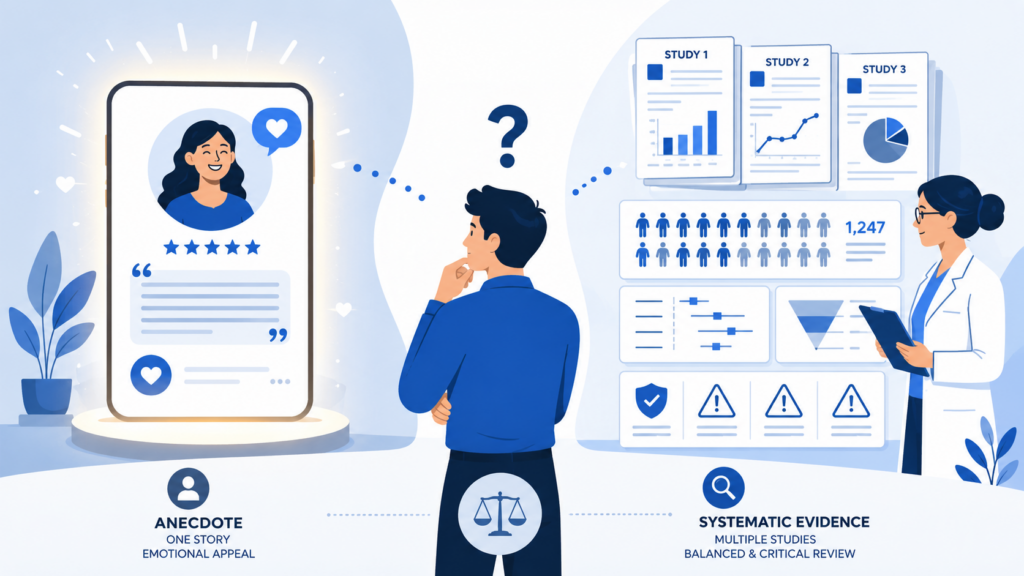
The belief becomes difficult to test because every outcome is interpreted as support.
Health claims are especially vulnerable to confirmation bias because symptoms naturally improve, illnesses vary, and people may use several treatments at once. Personal experiences feel powerful, but they often lack a control group, reliable measurement, and enough observations.
Health headlines can become even more misleading when they report only relative changes. Our guide to relative risk vs absolute risk explains why a dramatic percentage may represent a tiny real-world difference.
What can we learn? Treat personal stories as clues, not proof. Check clinical evidence, absolute risks, possible harms, and guidance from qualified healthcare professionals.
Confirmation Bias Example 6: Fake News
A fabricated story claims that a disliked public figure committed a shocking act. The headline matches what readers already believe about that person, so they share it without checking the original source.
Fake-news stories are among the most damaging confirmation bias examples because emotional agreement can replace source verification.
When a correction appears, it receives less attention. Some readers dismiss the correction as part of a cover-up, allowing the false belief to survive.
Fake news succeeds when emotional plausibility replaces verification. People ask, “Does this sound like something that person would do?” instead of, “What reliable evidence shows this happened?”
Our World in Data reports that public rebuttals can help counter misinformation, although their effects vary across audiences and existing beliefs.
What can we learn? Strong emotional agreement is a reason to slow down. Check the original source, publication date, supporting evidence, and independent reporting before sharing.
Confirmation Bias Example 7: Product Reviews
A shopper spends several days comparing laptops and gradually becomes attached to one model. After deciding, they focus on five-star reviews praising its screen and performance.
Negative reviews are dismissed as user error, unrealistic expectations, or isolated defects. The shopper may search for phrases such as “Why this laptop is the best” instead of “Common problems with this laptop.”
This is confirmation bias in everyday life because the research is no longer designed to find the best product. It is designed to reduce uncertainty about a preferred choice.
Review platforms can also distort perception through fake reviews, selective incentives, and unrepresentative samples.
Product reviews are especially useful confirmation bias examples because shoppers often search for reassurance after forming a preference.
What can we learn? Search directly for disadvantages, long-term failures, repair costs, and comparisons with competing products. Repeated complaints matter more than one dramatic review.
Confirmation Bias Example 8: Hiring Employees
A hiring manager forms a positive first impression within the opening minutes of an interview. The candidate is confident, attended a respected university, and shares an interest with the manager.
For the rest of the interview, the manager asks questions that allow the candidate to demonstrate strengths. Weak answers are interpreted generously. A quieter candidate receives more skeptical questions, and every hesitation becomes evidence of poor ability.
The manager may believe the decision is objective because they can list supporting facts. The bias lies in which facts they searched for and how they interpreted them.
Related selection bias examples show how unrepresentative applicant pools and screening methods can distort hiring before interviews even begin.
What can we learn? Use structured interviews, consistent questions, scoring rubrics, and multiple independent reviewers. Evaluate evidence before discussing first impressions.
Confirmation Bias Example 9: Relationships
A person begins to suspect that their partner is inconsiderate. They notice forgotten messages, late arrivals, and distracted conversations. Acts of care become invisible or are treated as exceptions.
Another person who believes their partner is highly dependable may explain the same behavior as stress, bad timing, or an innocent mistake.
Expectations shape interpretation. Once a relationship label forms, ambiguous behavior is repeatedly fitted into that story. This can create a self-reinforcing cycle: suspicion produces tension, tension changes behavior, and the changed behavior appears to confirm the suspicion.
Relationship conflicts can become confirmation bias examples when people repeatedly interpret ambiguous behavior through an existing belief.
What can we learn? Separate observable facts from interpretations. Instead of saying, “You never care,” identify the specific behavior, ask for context, and consider explanations that do not support your first assumption.
Confirmation Bias Example 10: Scientific Research
A researcher predicts that a new intervention will improve performance. During data analysis, several methods seem reasonable. The researcher may unconsciously prefer the method that produces a significant result and describe conflicting findings as unreliable.
Confirmation bias does not mean scientists routinely fabricate results. It can appear through subtle choices involving measurements, exclusions, statistical models, interpretation, and publication.
A Nature article examining ecological research notes that confirmation or observer bias can influence how scientists search for, interpret, and favor information before publication.
Safeguards such as preregistration, blinding, replication, transparent data, and peer criticism are designed to reduce these risks. Scientific objectivity depends on methods that expose ideas to possible failure, not on assuming researchers have no biases.
What can we learn? Strong research asks what evidence could reject a hypothesis. Results should remain credible when methods, exclusions, and alternative explanations are examined.
Confirmation Bias Example 11: Online Discussions
A person enters an online debate convinced that the other side is uninformed. They interpret every typo as proof of ignorance and every weak argument as representative of the entire opposing position.
Meanwhile, they ignore careful counterarguments and defend weak claims from people on their own side. Their goal has shifted from understanding the issue to winning the exchange.
Public discussions make confirmation bias stronger because admitting uncertainty can feel like losing status. Likes and supportive replies reward confident statements, while nuanced thinking receives less attention.
Stanford’s discussion of critical thinking notes that people with a hypothesis in mind tend to notice supporting evidence and ignore evidence favoring competing explanations.
What can we learn? State the strongest version of the opposing argument before responding. Ask what evidence would genuinely change your position.
Confirmation Bias Example 12: Everyday Shopping
A shopper believes expensive products are automatically better. In a store, they inspect the premium option closely, notice its attractive packaging, and interpret its higher price as evidence of quality.
They spend less time examining the cheaper product. If both perform equally well, the shopper may still report that the expensive one “feels better.”
The same bias can work in reverse. Someone convinced that all premium products are scams may ignore genuine differences in durability, support, or materials.
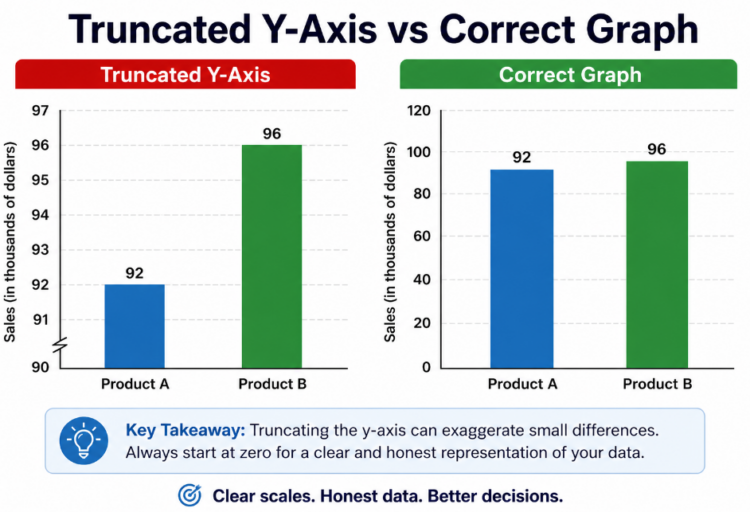
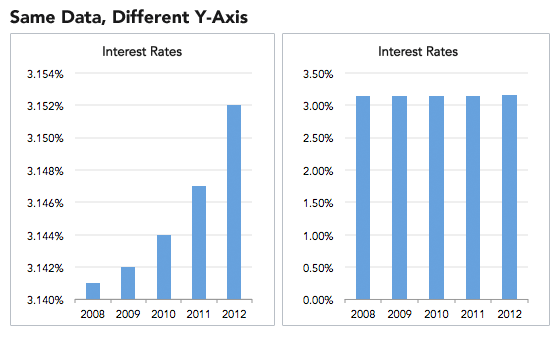
Marketing takes advantage of these expectations through branding, framing, selective comparisons, and visually impressive charts. Our collection of misleading graphs examples shows how presentation can exaggerate small differences.
What can we learn? Decide what features matter before seeing the price or brand. Compare measurable performance, total ownership cost, independent tests, and return policies.
How to Avoid Confirmation Bias
Once we recognize these confirmation bias examples, we can use practical strategies to make our decisions more balanced.
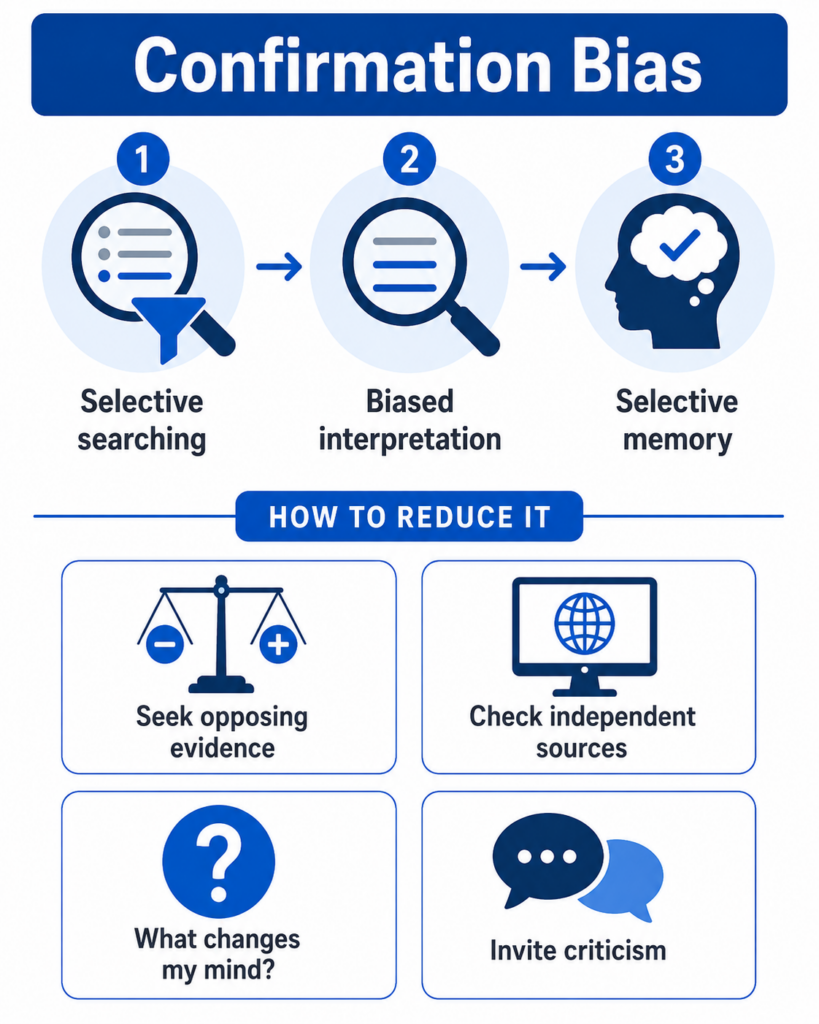
Confirmation bias cannot be eliminated completely, but it can be reduced through deliberate habits:
- Ask what would prove you wrong. Define disconfirming evidence before searching.
- Search for weaknesses, not reassurance. Use queries such as “problems with,” “evidence against,” and “limitations of.”
- Consult independent sources. Do not rely on several websites repeating the same original claim.
- Separate facts from interpretations. Write down what happened before explaining why it happened.
- Use consistent standards. Judge evidence from allies and opponents by the same rules.
- Delay important decisions. Emotional urgency makes familiar conclusions more attractive.
- Invite disagreement. Ask someone to challenge your reasoning rather than approve it.
- Check the full dataset. Averages, time periods, missing groups, and excluded cases can change the conclusion.
- Use a decision journal. Record your prediction, evidence, uncertainties, and conditions for changing course.
- Measure confidence. Replace “I know” with an estimated probability and update it when new evidence appears.
These methods work because they make opposing evidence easier to notice. They also reduce related thinking errors such as cherry picking and survivorship bias.
Why Confirmation Bias Matters
These real-life confirmation bias examples are not harmless quirks; they can influence decisions with financial, medical, political, and personal consequences.
Confirmation bias matters because small thinking errors can produce large consequences when they affect important decisions.
In misinformation, people share false claims that match their worldview. Repetition then makes those claims appear more credible.
In investing, people hold failing assets, ignore warning signs, or accept optimistic forecasts because selling would mean admitting a mistake.
In healthcare, patients may choose ineffective treatments, misread risk statistics, or delay appropriate care. Misleading percentages can make these decisions worse, especially when headlines omit baseline risks.
In elections, voters may evaluate similar behavior differently depending on which candidate or party is involved. Political groups can become more polarized as members consume different evidence.
In daily decisions, confirmation bias affects hiring, shopping, management, relationships, and problem-solving. It can also make misleading statistics more persuasive because people inspect agreeable numbers less carefully.
The central danger is not simply having a mistaken belief. It is building a reasoning process that protects the belief from correction.
FAQ
These questions address the most common concerns readers have after reviewing confirmation bias examples in politics, media, health, and daily decisions.
What is confirmation bias?
Confirmation bias is the tendency to search for, interpret, and remember information in ways that support an existing belief. Evidence that challenges the belief receives less attention or is judged more critically.
What is a real-life example of confirmation bias?
A common example is reading product reviews after choosing what you want to buy. You may focus on positive comments that justify the purchase while dismissing recurring complaints about reliability or value.
Why is confirmation bias dangerous?
It can prevent people from correcting mistakes. In serious areas such as healthcare, investing, elections, hiring, and scientific research, ignoring contradictory evidence can lead to costly or harmful decisions.
How can I reduce confirmation bias?
Look for evidence against your preferred conclusion, use multiple independent sources, define what would change your mind, invite criticism, and apply the same standards to evidence you agree and disagree with.
Is confirmation bias always bad?
Not always. Mental shortcuts can help people make quick decisions when time and information are limited. The problem arises when the shortcut blocks important evidence or creates unjustified confidence.
Is confirmation bias the same as cherry picking?
They are related but different. Confirmation bias is a psychological tendency to favor supporting information. Cherry picking is the act of selecting only the evidence that supports a claim. Confirmation bias can lead people to cherry-pick data without realizing it.
Can intelligent people experience confirmation bias?
Yes. Intelligence and expertise do not remove psychological bias. Skilled people may even become better at constructing convincing arguments for conclusions they already prefer.
What is the difference between confirmation bias and selection bias?
Confirmation bias affects how people search for and interpret evidence. Selection bias occurs when the people, cases, or observations included in an analysis do not represent the wider population being studied.
Conclusion
These confirmation bias examples show that biased thinking is rarely obvious from the inside. It often feels like careful research, common sense, loyalty, experience, or healthy skepticism.
The best defense is not to assume you are objective. It is to build habits that make your beliefs easier to test. Search for opposing evidence, check original sources, compare complete datasets, and decide in advance what could change your mind.
Recognizing confirmation bias will not make every decision perfect. It will make your reasoning more open, consistent, and responsive to evidence.
Download the free “25 Ways Statistics Can Mislead You” PDF to discover more practical thinking traps and learn how to identify them in news, charts, advertising, and everyday decisions.