Introduction
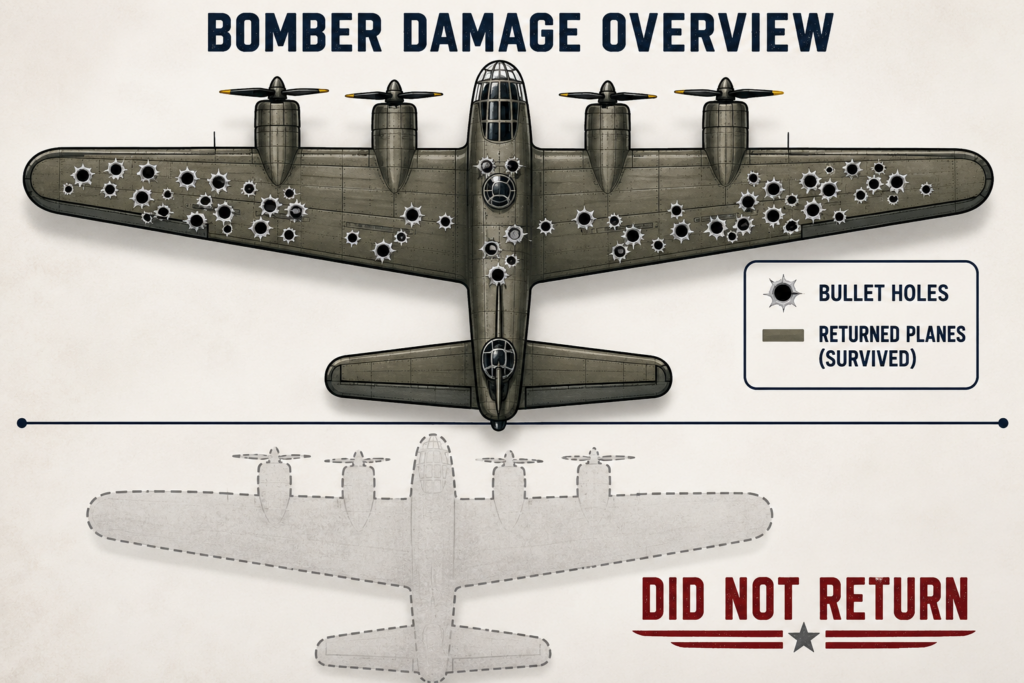
During World War II, military analysts studied the bullet holes on aircraft that returned from combat missions. The obvious idea was to add armor where the returning planes showed the most damage.
But there was a problem.
They were only looking at the planes that survived.
The missing aircraft, the ones that never came back, were the real clue. If surviving planes had bullet holes in certain areas, those areas were probably not fatal. The places with fewer bullet holes may have been the vulnerable spots, because planes hit there did not return.
That is the core of survivorship bias.
Survivorship bias appears everywhere from investing and business to social media, health, education, and everyday decisions.
Survivorship bias happens when we focus only on the people, companies, products, investments, or stories that survived, succeeded, or remained visible. This can create misleading statistics, misleading data, and false lessons. Learning to spot it is a powerful critical thinking skill.
Free PDF: Learn to Spot Misleading Statistics
Learn how to spot cherry picking, biased samples, misleading graphs, fake precision, and other common data tricks.
Download the free guide below.
Quick Answer: What Are Survivorship Bias Examples?
Survivorship bias examples are cases where people study only the visible winners, survivors, or successful outcomes while ignoring the failures that disappeared from view. This makes the data look more positive, more predictable, or more useful than it really is. Common examples include successful startup founders, investment funds that still exist, viral fitness transformations, old buildings, and famous career stories.
| Example | What People See | What They Miss | Why It Misleads |
|---|---|---|---|
| WWII aircraft | Bullet holes on returning planes | Planes that never returned | The missing data shows where damage was fatal |
| Startup founders | Famous companies that succeeded | Thousands of failed startups | Success looks easier and more repeatable |
| Investment funds | Funds still operating today | Closed or merged losing funds | Returns may look better than reality |
| Fitness transformations | Dramatic before-and-after photos | People who quit or saw no results | Results look more common than they are |
| Top student habits | Advice from high achievers | Students who used the same habits and failed | Habits may not be the true cause |
| Product reviews | Reviews from current users | People who returned or abandoned the product | Satisfaction may look inflated |
| Celebrity stories | Famous people who made it | Talented people who never became famous | Luck and access get ignored |
| Old buildings | Historic buildings still standing | Buildings that collapsed or were demolished | Old construction looks stronger than it was |
| Business books | Lessons from winning companies | Similar companies that failed | Winning patterns may be exaggerated |
| Social media creators | Creators with large audiences | Millions of inactive or failed accounts | Growth looks more predictable than it is |
| Medical stories | Survivors sharing treatment stories | People who did not recover | Anecdotes can distort treatment expectations |
| Job advice | Advice from people who got hired | Applicants who followed the same advice and were rejected | Hiring success looks formulaic |
What Is Survivorship Bias?
Survivorship bias is a statistical and thinking error that happens when we focus only on cases that passed through a selection process.
In simple terms, we study what survived and forget what disappeared.
This can mean:
- companies that are still in business
- investors who made money
- students who got into top schools
- athletes who became professionals
- creators who went viral
- patients who recovered
- products that still have loyal users
The problem is not that the surviving cases are fake. The problem is that they are incomplete.
Survivorship bias in statistics is dangerous because the missing cases may completely change the conclusion. If only winners are analyzed, success looks easier. If only survivors are interviewed, risks look smaller. If only existing companies are counted, failure becomes invisible.
A simple way to remember it:
Survivorship bias happens when the data only includes what made it through.
Why Survivorship Bias Matters

Survivorship bias matters because it hides the full story.
Many misleading statistics examples are not caused by wrong math. They are caused by missing data. The numbers may be calculated correctly, but the dataset itself is incomplete.
This matters in:
- Business: studying only successful companies can create false formulas for success.
- Investing: analyzing only surviving funds can exaggerate returns.
- Education: copying habits from top students may ignore people who tried the same habits and failed.
- Social media: viral creators make growth look easier than it is.
- Product reviews: feedback from current users can exclude disappointed customers.
- Health: survivor stories can make treatments seem more effective than they are.
- History: objects that survived may not represent the past accurately.
- Data interpretation: visible examples can feel more important than invisible failures.
Survivorship bias is one reason critical thinking matters. Whenever a claim is based only on visible success, ask what failed, disappeared, or never got counted.
Survivorship bias is one of many misleading statistics examples that can make accurate numbers support the wrong conclusion.
12 Survivorship Bias Examples
1. World War II Airplane Armor
The World War II aircraft example is one of the most famous survivorship bias examples.
Military analysts looked at planes that returned from combat and saw bullet holes in the wings and fuselage. A simple interpretation was to add armor where the bullet holes appeared most often.
But that interpretation missed the most important data: the planes that did not return.
If a plane came back with damage in certain areas, that damage was survivable. The real danger may have been in the areas where returning planes had fewer bullet holes, because planes hit there were more likely to crash.
The classic story is often associated with Abraham Wald and the aircraft armor problem.
Why It Misleads
The analysis focused only on surviving aircraft. It treated the visible damage as the full dataset, even though the destroyed planes were missing.
This is a classic example of how missing data can reverse the conclusion.
What to Check
Ask:
- What cases are missing?
- Did the failed cases disappear before they could be measured?
- Are we studying survivors instead of the original population?
2. Successful Startup Founders

Startup advice often comes from founders who built successful companies.
They may say things like:
- take big risks
- drop out of school
- ignore critics
- work nonstop
- raise money fast
- move quickly
Some of this advice may be useful. But it often comes from people who survived the startup process.
For every famous founder, there are many founders who took big risks, worked hard, ignored critics, and still failed.
Why It Misleads
The visible founders are not a representative sample of all founders. They are the survivors.
If you only study successful startups, it can look like success follows a clear formula. But failed startups may have followed the same formula and disappeared.
What to Check
Before accepting startup advice, ask:
- How many similar startups failed?
- Did the same strategy work for most founders or only for survivors?
- What role did timing, luck, funding, location, or network access play?
3. Investment Funds That Still Exist
Investment performance can be distorted by survivorship bias.
Imagine comparing mutual funds that exist today. The list may exclude funds that performed badly and were closed, merged, or renamed.
If only surviving funds are included, average performance may look stronger than it really was.
This can make an investment strategy seem safer or more profitable than it actually is.
In finance, survivorship bias risk can distort how investors interpret historical performance.
Why It Misleads
Poor performers often disappear from the dataset. When failed funds are removed, the remaining funds look better by comparison.
This is a common issue in backtesting and historical performance analysis.
What to Check
Ask:
- Does the dataset include closed funds?
- Were losing investments removed?
- Does the analysis include all funds that existed at the start of the period?
- Are the results based only on today’s survivors?
4. Fitness Transformations Online
Social media is full of dramatic fitness transformations.
You may see someone who lost weight, gained muscle, or changed their body in a few months. The post often includes a simple routine, a diet plan, or a motivational message.
But the people who post successful transformations are not the full sample.
Many people may have tried the same routine and quit. Others may have followed the plan and seen limited results. Some may have had injuries, health conditions, different schedules, or different starting points.
Why It Misleads
Visible success stories make dramatic results seem more common than they are.
The failures are less visible because people rarely post unfinished programs, abandoned routines, or disappointing results.
What to Check
Ask:
- How many people started the same program?
- What percentage got similar results?
- Were unsuccessful attempts included?
- Are there differences in age, genetics, diet, time, coaching, or previous training?
5. “Top Student Habits” Advice
Many articles claim to reveal the habits of top students.
They may say successful students:
- wake up early
- study every day
- use flashcards
- take handwritten notes
- avoid social media
- plan their week
These habits can be helpful. But survivorship bias appears when we assume the habits caused the success just because successful students have them.
Some students may use the same habits and still struggle. Others may succeed because of prior knowledge, tutoring, family support, school quality, test-taking ability, or time availability.
Why It Misleads
The advice studies students who succeeded and works backward.
That can confuse common traits with actual causes. It also ignores students who used the same habits but did not get the same outcome.
What to Check
Ask:
- Did unsuccessful students also use these habits?
- Were students compared before and after using the strategy?
- Are there hidden advantages, such as tutoring or prior preparation?
- Is the advice based on evidence or personal anecdotes?
6. Product Reviews From Active Customers Only
Product reviews can suffer from survivorship bias when they mostly reflect active users.
For example, a software company may survey current customers and report high satisfaction. But current customers are the people who stayed.
What about customers who canceled after one month? What about users who returned the product, deleted the app, or never completed setup?
Those people may be missing from the review pool.
Why It Misleads
Current users are often more satisfied than former users. If former users are excluded, the product may look better than it is.
This is especially important for subscription tools, apps, online courses, and digital products.
What to Check
Ask:
- Are reviews from all buyers or only active users?
- Are cancellations included?
- Are refunds included?
- Are reviews collected immediately after purchase or after long-term use?
- Are negative reviews filtered or harder to find?
7. Celebrity Success Stories
Celebrity success stories often focus on persistence, talent, and confidence.
The message is usually inspiring: they believed in themselves, kept going, and eventually succeeded.
That can be true. But it is not the full story.
Many talented people work hard for years and never become famous. Others face financial limits, family responsibilities, discrimination, lack of connections, poor timing, or simple bad luck.
Survivor stories can also overlap with correlation vs causation examples when people assume a visible habit caused success.
Why It Misleads
Celebrity stories focus on people who survived an extremely competitive selection process.
Because the failures are invisible, fame can look more controllable than it is. The story becomes “work hard and you will succeed,” even though many people work hard and do not reach the same outcome.
What to Check
Ask:
- How many people attempted the same path?
- What happened to equally talented people who did not become famous?
- Did the story ignore luck, timing, networks, or inherited advantages?
- Is the example being used as proof of a general rule?
8. Old Buildings That Still Stand
People sometimes look at old buildings and conclude that construction was better in the past.
They see castles, temples, churches, bridges, or historic homes that have survived for centuries. Then they compare them with modern buildings and assume older construction was always superior.
But this ignores the old buildings that collapsed, burned down, were demolished, or became unsafe.
The buildings still standing today are the survivors.
Why It Misleads
Surviving buildings are not representative of all buildings from the past.
Weak structures disappeared. Stronger, better-maintained, or more culturally important buildings were preserved. The visible sample is filtered.
What to Check
Ask:
- How many similar buildings no longer exist?
- Were surviving buildings maintained or restored?
- Were only important buildings preserved?
- Are we comparing ordinary modern buildings with exceptional historical survivors?
9. Business Books About Winners
Many business books study successful companies and try to identify why they won.
They may highlight:
- strong leadership
- bold strategy
- company culture
- customer obsession
- innovation
- speed
- discipline
The problem is that many failed companies may also have had those traits.
If a book studies only winners, it may mistake common business language for a proven success formula.
Why It Misleads
Studying winners alone cannot show whether a trait caused success.
To understand what matters, you need to compare winners with similar losers. Otherwise, the analysis may simply describe survivors after the fact.
What to Check
Ask:
- Did the analysis include failed companies?
- Were similar companies compared?
- Could the same traits be found in businesses that collapsed?
- Is the book explaining success after it already happened?
10. Social Media Creators Who “Made It”
Successful creators often share advice about how they grew.
They may say:
- post daily
- use short videos
- follow trends
- build a personal brand
- be authentic
- engage with your audience
This advice may help. But survivorship bias appears when people assume that following the advice will produce similar results.
Millions of creators post consistently and never grow large audiences. Many quit before becoming visible. Others are buried by algorithm changes, niche limits, platform timing, or competition.
Why It Misleads
Social media shows the winners more than the failed attempts.
When only successful creators explain the process, growth looks more predictable than it really is.
What to Check
Ask:
- How many creators followed the same advice and failed?
- Did timing or platform luck matter?
- Was the creator already connected, famous, attractive, wealthy, or unusually skilled?
- Is the advice based on broad data or one personal story?
11. Medical Treatment Stories From Survivors
Health stories can be powerful and emotional.
A person may say that a specific treatment, diet, supplement, routine, or alternative therapy saved their life. Their story may be sincere and meaningful.
But survivor stories are not the same as medical evidence.
People who recover are more likely to share their experience. People who did not recover may be absent from the conversation. Others may have used several treatments at once, making it hard to know what actually helped.
Personal survivor stories should be compared with broader medical evidence before drawing conclusions.
Why It Misleads
Survivor stories can make a treatment seem more effective than it is.
This is especially risky when anecdotes are used instead of controlled evidence. The missing group, people who tried the same thing and did not improve, is essential.
What to Check
Ask:
- How many people tried the treatment?
- How many improved, stayed the same, or got worse?
- Was there a control group?
- Could recovery have happened for another reason?
- Is the claim supported by reliable medical evidence?
12. Job Advice From People Who Were Hired
Job advice often comes from people who successfully got hired.
They may recommend:
- a specific resume format
- a cover letter style
- a networking strategy
- a LinkedIn message template
- a certain interview answer
- a portfolio structure
This advice can be useful. But it may also be affected by survivorship bias.
Many applicants may have followed similar advice and still been rejected. Hiring decisions can depend on timing, competition, internal referrals, location, salary expectations, industry demand, and interviewer preferences.
Why It Misleads
People who got hired may overestimate the role of their strategy.
They know what they did, but they often do not know how many rejected applicants did the same thing.
What to Check
Ask:
- Did rejected candidates use similar methods?
- Was the advice tested across many applicants?
- Did the person have advantages such as referrals or prior experience?
- Is the advice specific to one company, industry, or hiring manager?
Survivorship Bias vs Selection Bias
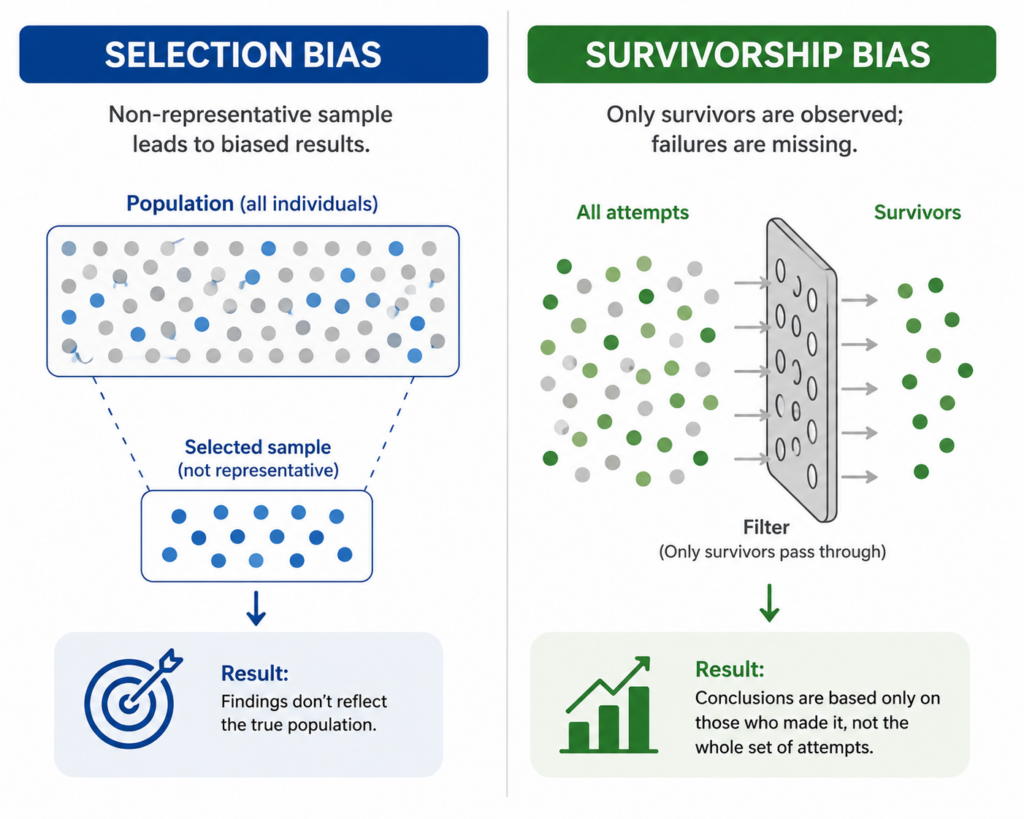
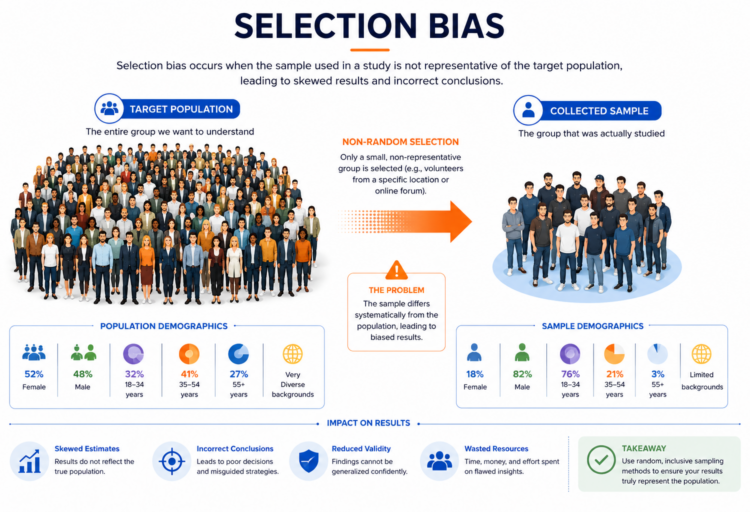
Survivorship bias is a type of selection bias.
Selection bias happens when the data sample does not represent the population being studied. Some people, events, or outcomes are included, while others are excluded.
Survivorship bias is more specific. It happens when the excluded cases are the ones that did not survive, succeed, remain visible, or make it through a filtering process.
Here is the difference:
- Selection bias: the sample is not representative.
- Survivorship bias: the sample is not representative because only survivors remain visible.
For example, surveying only college students about national political opinions is selection bias. Studying only startups that became successful is survivorship bias.
Survivorship bias examples are often easier to miss because the missing cases are not just ignored. They may be gone completely.
For more related cases, see these selection bias examples that show how non-representative samples distort reality.
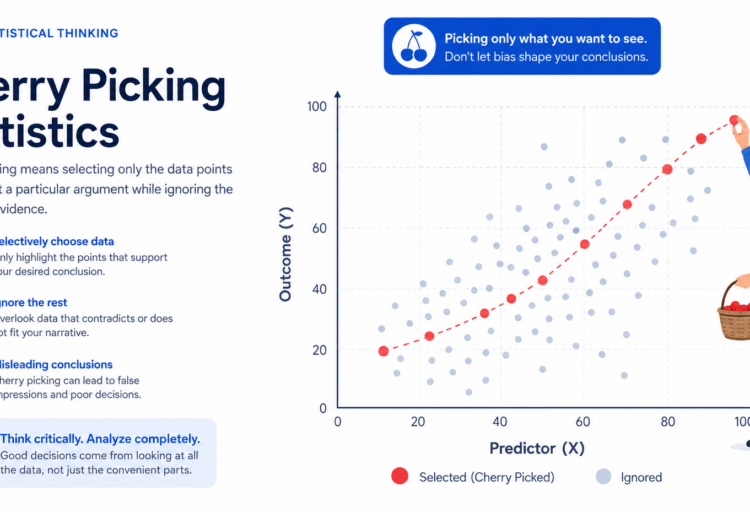
Survivorship Bias vs Cherry Picking
Survivorship bias and cherry picking are related, but they are not the same.
Cherry picking happens when someone intentionally selects data that supports a preferred conclusion and ignores data that contradicts it.
Survivorship bias can happen even without intention. The missing data may be naturally hidden because failed companies closed, rejected applicants disappeared, unhappy customers left, or unsuccessful creators quit.
The difference is:
- Cherry picking: someone selects favorable evidence.
- Survivorship bias: the available evidence is already filtered toward survivors.
Both can create misleading data examples. Both can make a weak argument look stronger than it is. But survivorship bias is often more subtle because the missing cases may not be obvious.
This problem often appears alongside other misleading data examples where missing context changes the meaning of a claim.
To compare this with intentional selective evidence, read these cherry picking statistics examples.
Common Types of Survivorship Bias
Business Survivorship Bias
Business survivorship bias happens when people study successful companies and ignore failed ones.
This can make certain strategies look more reliable than they are. It can also create false business lessons based on winners only.
Investment Survivorship Bias
Investment survivorship bias happens when performance data excludes funds, companies, or strategies that failed.
This can exaggerate average returns and underestimate risk.
Media Survivorship Bias
Media survivorship bias happens when news, interviews, documentaries, and profiles focus on winners.
Failures receive less attention because they are less visible and less marketable.
Health Survivorship Bias
Health survivorship bias happens when survivor stories are treated as proof.
This is especially risky when personal anecdotes replace broader evidence.
Historical Survivorship Bias
Historical survivorship bias happens when surviving artifacts, buildings, documents, or stories are treated as representative of the past.
What survived may not reflect what was common.
Online Review Survivorship Bias
Online review survivorship bias happens when reviews mostly come from current users, loyal customers, or people with extreme experiences.
Former users, refunded customers, and silent dissatisfied users may be missing.
How to Spot Survivorship Bias
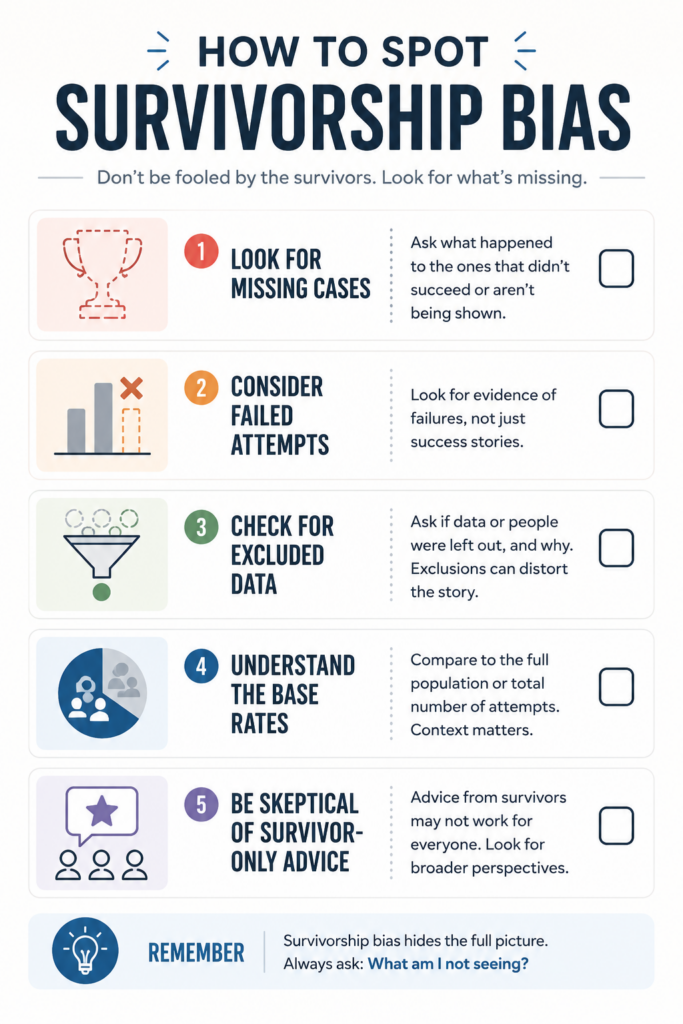
Use this checklist whenever you see a success story, performance claim, ranking, case study, or expert lesson.
- Ask what failed. What companies, people, products, or attempts disappeared?
- Look for missing cases. Who is not visible in the data?
- Check who was excluded. Was the sample filtered before analysis?
- Compare survivors with non-survivors. Do the same traits appear in failed cases?
- Question success stories. Is the story inspiring but incomplete?
- Look for base rates. How common is the outcome among everyone who tried?
- Check the original population. Who started the process, not just who finished?
- Watch for winner-only advice. Advice from survivors may not apply to everyone.
- Separate anecdotes from evidence. One story does not represent the full dataset.
A simple question often reveals the problem:
What would the data look like if the failures were included?
How to Avoid Survivorship Bias
You cannot always eliminate survivorship bias completely, but you can reduce it.
Start by expanding the dataset.
Instead of studying only winners, include failures. Instead of analyzing only active customers, include canceled accounts. Instead of looking only at current funds, include closed funds. Instead of listening only to hired applicants, study rejected applicants too.
Practical steps include:
- Include failures. Do not study only successful cases.
- Use representative data. Make sure the sample reflects the full population.
- Study the full sample. Look at who started, not just who finished.
- Compare before and after filtering. Ask what changed when cases disappeared.
- Avoid learning only from winners. Study failed attempts with equal attention.
- Look for data that is not easily visible. Missing cases often hold the real lesson.
- Track dropouts and exits. People who leave may explain more than people who stay.
- Be careful with case studies. A case study can illustrate an idea, but it rarely proves a rule.
The goal is not to ignore success stories. The goal is to stop treating survivors as if they represent everyone.
Why People Fall for Survivorship Bias
People fall for survivorship bias because survivors are easy to see.
Success stories are memorable. They are emotional, simple, and satisfying. They often have a clear beginning, middle, and ending. Failure stories are messier and less visible.
Several psychological forces make survivorship bias powerful:
- Success stories are memorable. We remember winners more easily than invisible failures.
- Failures are hidden. Failed companies close, rejected applicants move on, and abandoned projects disappear.
- Media prefers winners. Successful people make better headlines.
- People like simple formulas. “Do these five things to succeed” is more appealing than uncertainty.
- Survivors are easier to interview. They are available, visible, and often willing to explain their success.
- Outcome bias feels natural. Once something succeeds, people assume the process must have been smart.
- Luck is uncomfortable. People prefer stories where success feels controllable.
Survivorship bias gives people a clean story. But clean stories are not always accurate stories.
Recommended Books on Statistical Bias and Critical Thinking
- How to Lie with Statistics by Darrell Huff
Useful for understanding how numbers can mislead through missing context, weak samples, and selective presentation. - The Art of Statistics by David Spiegelhalter
Useful for readers who want a clearer foundation in uncertainty, evidence, and real-world statistical thinking. - Thinking, Fast and Slow by Daniel Kahneman
Useful for understanding cognitive biases and why people trust incomplete stories.
Affiliate disclosure text:
As an Amazon Associate, EmpireStats may earn from qualifying purchases.
Recommended Books on Statistical Bias and Critical Thinking
If you want to understand survivorship bias, misleading statistics, and data bias examples more deeply, these books are useful starting points.
- How to Lie with Statistics by Darrell Huff
A classic introduction to how numbers can mislead when context, samples, and definitions are unclear. - The Art of Statistics by David Spiegelhalter
A clear guide to statistical thinking, uncertainty, risk, and real-world data interpretation. - Thinking, Fast and Slow by Daniel Kahneman
A useful book for understanding cognitive biases, judgment errors, and why people trust incomplete stories.
As an Amazon Associate, EmpireStats may earn from qualifying purchases.
FAQ
What is survivorship bias?
Survivorship bias is the error of focusing only on people, objects, companies, or outcomes that survived a process while ignoring those that failed or disappeared. It can make success look easier, risks look smaller, and patterns look more reliable than they are.
For a behavioral explanation, The Decision Lab provides a useful overview of survivorship bias.
What is a simple example of survivorship bias?
A simple example is studying only successful startups to learn how companies succeed. This ignores the many startups that followed similar advice and still failed. Without those failed cases, the lesson may be misleading.
Why is survivorship bias misleading?
Survivorship bias is misleading because it hides missing data. When failures are excluded, the remaining examples can make an outcome look more common, more predictable, or less risky than it really is.
Is survivorship bias a type of selection bias?
Yes. Survivorship bias is a type of selection bias. Selection bias happens when a sample is not representative. Survivorship bias happens when the sample is distorted because only survivors remain visible.
What is the difference between survivorship bias and selection bias?
Selection bias is the broader problem of using a non-representative sample. Survivorship bias is a specific form of selection bias where the sample includes only cases that survived, succeeded, or passed through a filtering process.
What is survivorship bias in business?
Survivorship bias in business happens when people study successful companies and ignore failed companies. This can create false lessons about strategy, leadership, innovation, or company culture.
What is survivorship bias in investing?
Survivorship bias in investing happens when analysis includes only investments, funds, or companies that still exist. If failed or closed investments are excluded, historical performance may look better than it really was.
How do you spot survivorship bias?
To spot survivorship bias, ask what failed, who disappeared, and whether the analysis includes the full original population. If the data only includes winners, active users, current companies, or visible success stories, survivorship bias may be present.
How can you avoid survivorship bias?
You can avoid survivorship bias by including failures, using representative data, studying the full sample, comparing survivors with non-survivors, and questioning advice based only on success stories.
Why do people fall for survivorship bias?
People fall for survivorship bias because winners are visible and failures are hidden. Success stories are easier to remember, easier to share, and more emotionally satisfying than incomplete datasets.
Conclusion
These survivorship bias examples show how easy it is to mistake visible success for the full story.
From World War II aircraft and startup founders to investment funds, product reviews, social media creators, and medical survivor stories, the same pattern appears again and again. We see what survived, but we forget to ask what disappeared.
That is why survivorship bias is one of the most important concepts behind misleading statistics and misleading data. The numbers may look convincing, but the missing cases may completely change the conclusion.
Whenever you see a success story, a ranking, a case study, or a confident lesson from winners, pause before accepting it.
The most important data may be the data you cannot see.